
Paid Ads: 20 Costly Advertising Mistakes to Avoid in 2026
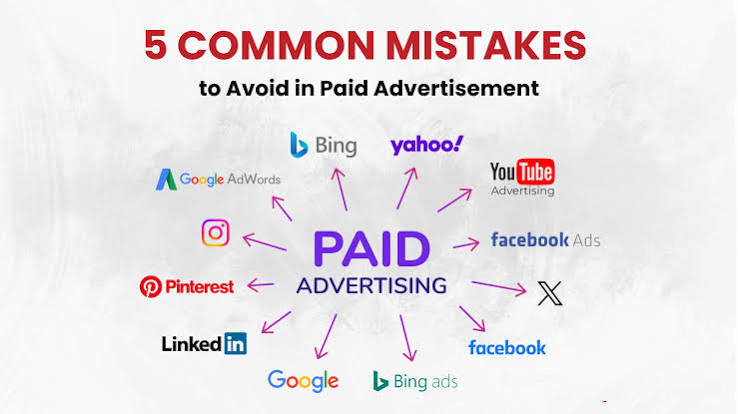
Paid advertising has become one of the fastest ways for businesses to generate leads, sales, and brand awareness. Paid Ads: 20 Costly Advertising Mistakes to Avoid in 2026. Whether you’re running campaigns on Google Ads, Meta Ads, or LinkedIn Ads, your success depends less on how much you spend and more on how effectively you spend it.https://mentorfluence.online/#home
Many businesses assume that increasing their ad budget automatically leads to more sales. Unfortunately, this isn’t true. Poor targeting, weak creatives, ineffective bidding strategies, and neglected campaign optimization can quickly turn profitable campaigns into expensive failures.
In India alone, businesses waste thousands of rupees every month on poorly managed PPC campaigns. From startups and local businesses to established brands, many advertisers unknowingly make mistakes that damage their CTR, increase CPC, lower conversion rates, and reduce ROAS.
This guide covers the 20 biggest paid advertising mistakes that marketers, agencies, and businesses should avoid if they want to maximize results and reduce ad spend wastage.
https://advertising.amazon.com/library/guides/paid-advertising
Why Paid AdS Fails
Paid media works because it allows businesses to reach the right audience at the right time with the right message. However, digital advertising platforms https://mailchimp.com/resources/paid-ads/ have become increasingly competitive.
Higher competition means:
- Rising CPC costs
- Lower organic visibility
- Increased ad fatigue
- Higher customer acquisition costs
- More pressure on campaign profitability
To succeed in performance marketing, advertisers must continuously optimize campaigns instead of relying on a “set it and forget it” strategy.
Paid Ads Mistake #1: Launching Campaigns Without Clear Goals
One of the biggest PPC mistakes is running campaigns without defining success metrics.
Are you optimizing for:
- Leads?
- Website traffic?
- App installs?
- Purchases?
- Brand awareness?
Without clear goals, it’s impossible to evaluate campaign performance accurately.
For example:
- Ecommerce businesses often focus on ROAS.
- Service businesses prioritize CPA.
- Publishers may optimize for CTR.
- SaaS companies typically track conversion rate and customer lifetime value.
Every campaign should have one primary objective.
Paid AdsMistake #2: Ignoring Audience Research
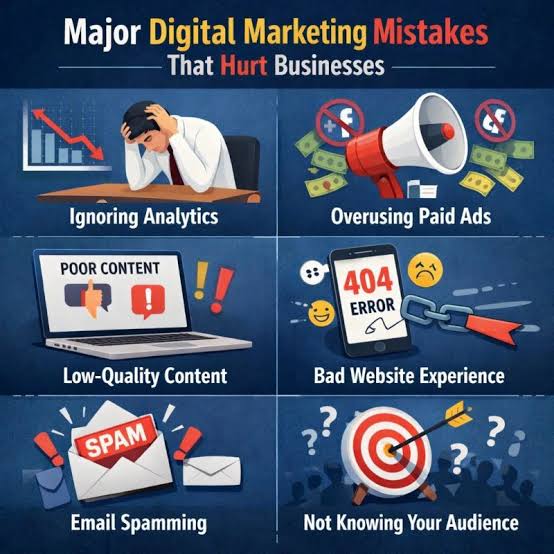
Targeting everyone usually means converting no one.
Successful paid media campaigns rely heavily on audience research, including:
- Age groups
- Income levels
- Locations
- Interests
- Buying behavior
- Search intent
A premium product targeting college students may struggle to generate conversions, while the same product marketed to working professionals could perform exceptionally well.
Audience understanding directly impacts CTR and conversion rate.
Paid Ads Mistake #3: Choosing the Wrong Platform
Different platforms serve different purposes.
Search Advertising
Best for high purchase intent users actively searching for solutions.
Example:
Users searching for “best digital marketing course in Delhi.”
Ideal platform:
Google Ads
Social Advertising
Best for awareness and impulse purchases.
Ideal platforms:
Meta Ads
Professional B2B Advertising
Best for decision-makers and businesses.
Ideal platform:
LinkedIn Ads
Selecting the wrong platform often leads to wasted ad spend and poor campaign performance.
Paid Ads Mistake #4: Poor Keyword Selection
Keywords determine who sees your ads.
Common keyword mistakes include:
- Targeting broad keywords
- Ignoring long-tail keywords
- Using irrelevant search terms
- Failing to update keyword lists
For example:
“marketing” is too broad.
“digital marketing course for beginners in Delhi” is highly targeted.
Long-tail keywords generally offer:
- Lower CPC
- Better conversion rate
- Higher quality traffic
Paid Ads Mistake #5: Ignoring Negative Keywords
Negative keywords are one of the most underutilized optimization techniques.
Suppose you sell premium consulting services.
You may want to exclude searches like:
- Free
- Cheap
- Download
- Internship
Negative keywords prevent irrelevant clicks and improve campaign efficiency.
Benefits include:
- Lower CPC
- Better Quality Score
- Higher ROAS
- Improved lead quality
Paid Ads Mistake #6: Writing Weak Ad Copy
Your ad copy determines whether users click or ignore your advertisement.
Poor ads often:
- Lack urgency
- Provide no value proposition
- Use generic messaging
- Ignore customer pain points
Strong ad copy includes:
- Benefits
- Numbers
- Social proof
- Clear CTAs
Example:
Bad:
“Digital Marketing Services Available”
Good:
“Increase Leads by 40% with Data-Driven Marketing Campaigns”
Compelling copy improves CTR and ad rank.
Paid Ads Mistake #7: Ignoring Quality Score
Quality Score remains one of the most important factors in PPC success.
It influences:
- CPC
- Ad rank
- Visibility
- Cost efficiency
A high Quality Score often results in lower costs and better placements.
Major factors include:
- Expected CTR
- Landing page experience
- Ad relevance
- Keyword relevance
Improving Quality Score can reduce advertising costs significantly.
Paid Ads Mistake #8: Sending Traffic to Poor Landing Pages
Many businesses invest heavily in advertising but neglect landing page optimization.
Common landing page issues include:
- Slow loading speed
- Weak headlines
- Poor mobile experience
- Confusing layouts
- Lack of trust signals
Even excellent ads cannot compensate for bad landing pages.
The conversion journey starts with the ad but finishes on the website.
Paid Ads Mistake #9: Ignoring Mobile Users
More than half of digital traffic comes from smartphones.
Yet many advertisers still optimize exclusively for desktop users.
Mobile optimization includes:
- Fast page speed
- Responsive design
- Click-to-call buttons
- Short forms
- Easy navigation
Mobile-first optimization can dramatically improve conversion rates.
Paid Ads Mistake #10: Not Tracking Conversions Properly
Clicks do not equal success.
Businesses should track:
- Leads
- Purchases
- Calls
- Form submissions
- Revenue generated
Without conversion tracking, optimization becomes guesswork.
Platforms such as Google Analytics provide valuable insights into user behavior and campaign performance.
Paid Ads Mistake #11: Using the Wrong Bid Strategy
Bid strategy has a direct impact on profitability.
Popular strategies include:
- Manual CPC
- Maximize Clicks
- Maximize Conversions
- Target CPA
- Target ROAS
Modern advertisers increasingly rely on Smart Bidding technologies available on Google Ads.
Choosing the wrong bidding method often results in inefficient spending.
Paid Ads Mistake #12: Ignoring Smart Bidding Opportunities
Smart Bidding uses machine learning to optimize bids in real time.
It considers:
- Device
- Location
- User behavior
- Time of day
- Historical conversion patterns
Businesses using Smart Bidding often achieve better scalability and efficiency.
However, Smart Bidding performs best when accurate conversion tracking is already in place.
Paid Ads Mistake #13: Running Too Many Campaign Changes Simultaneously
Changing targeting, budget, bidding, and creatives at the same time creates confusion.
If results improve or worsen, identifying the reason becomes difficult.
Best practice:
Change one variable at a time.
This principle forms the foundation of effective A/B testing.
Paid Ads Mistake #14: Ignoring A/B Testing
A/B testing is one of the most powerful optimization tools in digital advertising.
Elements worth testing include:
- Headlines
- Images
- CTA buttons
- Landing pages
- Offers
- Target audiences
Small improvements compound over time.
A 10% increase in CTR combined with a 10% increase in conversion rate can dramatically improve profitability.
Paid Ads Mistake #15: Failing to Monitor Ad Fatigue
Ad fatigue occurs when users repeatedly see the same advertisements.
Symptoms include:
- Falling CTR
- Rising CPC
- Lower engagement
- Reduced conversions
Creative refresh cycles are essential.
Most advertisers should update creatives every few weeks depending on audience size and frequency.
Paid Ads Mistake #16: Neglecting Remarketing Campaigns
Most website visitors do not convert during their first visit.
Remarketing helps businesses reconnect with previous visitors.
Benefits include:
- Higher conversion rates
- Lower acquisition costs
- Better ROAS
- Increased customer retention
Retargeting campaigns often outperform cold audience campaigns because they target users already familiar with the brand.
Paid Ads Mistake #17: Ignoring Customer Lifetime Value
Many businesses focus only on first purchase profitability.
This approach can be misleading.
Consider:
Customer acquisition cost: ₹1,000
First purchase profit: ₹500
Lifetime value: ₹10,000
Despite losing money initially, the customer remains highly profitable over time.
Understanding customer lifetime value improves bid decisions and budget allocation.
Paid Ads Mistake #18: Poor Budget Allocation
Budget allocation is a critical component of media buying.
Common mistakes include:
- Overspending on low-performing campaigns
- Underfunding winning campaigns
- Equal distribution across all channels
Performance marketing requires budget flexibility.
Winning campaigns deserve additional investment.
Underperforming campaigns require optimization or pausing.
Paid Ads Mistake #19: Ignoring Campaign Audits
Regular campaign audits help identify hidden issues before they become expensive problems.
Audit areas include:
- Keyword performance
- Audience quality
- Landing pages
- Conversion tracking
- Ad relevance
- Device performance
Monthly audits are recommended for most businesses.
Large advertisers often conduct weekly reviews.
Paid Ads Mistake #20: Measuring Vanity Metrics Instead of Business Results
Many advertisers celebrate:
- Impressions
- Likes
- Shares
- Clicks
However, these metrics do not always translate into revenue.
Businesses should prioritize:
- ROAS
- CPA
- Revenue
- Profit margin
- Customer lifetime value
Performance marketing focuses on business outcomes rather than surface-level engagement.
Understanding Key PPC Metrics
CTR (Click-Through Rate)
CTR measures how many people click after seeing your ad.
Formula:
Clicks ÷ Impressions × 100
Higher CTR generally indicates strong ad relevance.
CPC (Cost Per Click)
CPC measures the amount paid for each click.
Lower CPC allows advertisers to generate more traffic with the same budget.
CPA (Cost Per Acquisition)
CPA measures the cost required to generate a customer or lead.
Lower CPA often indicates greater campaign efficiency.
Conversion Rate
Conversion rate measures the percentage of users who complete desired actions.
Formula:
Conversions ÷ Visitors × 100
ROAS (Return on Ad Spend)
ROAS is one of the most important ecommerce metrics.
Formula:
Revenue Generated ÷ Advertising Spend
Example:
Revenue = ₹200,000
Ad Spend = ₹50,000
ROAS = 4x
This means every ₹1 spent generated ₹4 in revenue.
Ad Rank
Ad rank determines advertisement placement.
It depends on:
- Bid amount
- Quality Score
- Expected CTR
- Ad relevance
Higher ad rank improves visibility.
The Rise of Performance Max Campaigns
Many businesses now use Performance Max campaigns.
Performance Max uses automation across:
- Search
- Display
- YouTube
- Gmail
- Maps
Advantages include:
- Wider reach
- Automated optimization
- Cross-channel visibility
However, advertisers should still monitor performance closely rather than relying entirely on automation.
Paid Media Trends in India
India’s digital advertising industry continues to grow rapidly.
Businesses are investing heavily in:
- Ecommerce advertising
- Local service campaigns
- Lead generation
- Video marketing
- Mobile advertising
With increasing competition, campaign optimization becomes more important than ever.
Advertisers must also account for taxation requirements such as GST when calculating profitability and ad spend.
Ignoring taxes can distort ROAS calculations and budgeting decisions.
How to Reduce Ad Spend Wastage
To reduce advertising waste:
- Use negative keywords.
- Improve targeting.
- Conduct campaign audits.
- Refresh creatives regularly.
- Optimize landing pages.
- Monitor Quality Score.
- Track conversions accurately.
- Run A/B tests continuously.
These steps can significantly improve profitability.
The Future of PPC Advertising
Artificial intelligence and automation are transforming paid media.
Emerging trends include:
- Predictive bidding
- Automated creative generation
- Advanced audience segmentation
- AI-driven optimization
- Cross-platform attribution
Advertisers who combine automation with human strategy will gain the greatest competitive advantage.
Final Thoughts
Paid advertising remains one of the most effective methods for growing a business, but success requires more than simply increasing budgets.
The most successful advertisers focus on:
- Data-driven decisions
- Continuous optimization
- Audience understanding
- Creative testing
- Strategic budget allocation
Avoiding these 20 mistakes can improve CTR, lower CPC, reduce CPA, increase conversion rates, and maximize ROAS.
Whether you’re managing campaigns on Google, Facebook, Instagram, or LinkedIn, the fundamentals remain the same:
Reach the right audience, deliver the right message, and optimize relentlessly.
Businesses that treat PPC as an ongoing process rather than a one-time setup are the ones that consistently outperform competitors and generate sustainable growth in the ever-evolving world of digital advertising.